

PROJECTS
DAILY MIRROR(S)
Solo exhibition at the Parque das Ruínas Museum
Rio de Janeiro, 2006

Vista da Instalação dimensões variáveis Centro Cultural Parque das Ruínas

Vista da Instalação Esfera em resina e prata, grafite 100cm de diâmetro

[detalhe] holografia sobre bijoux e veludo Centro Cultural Parque das Ruínas
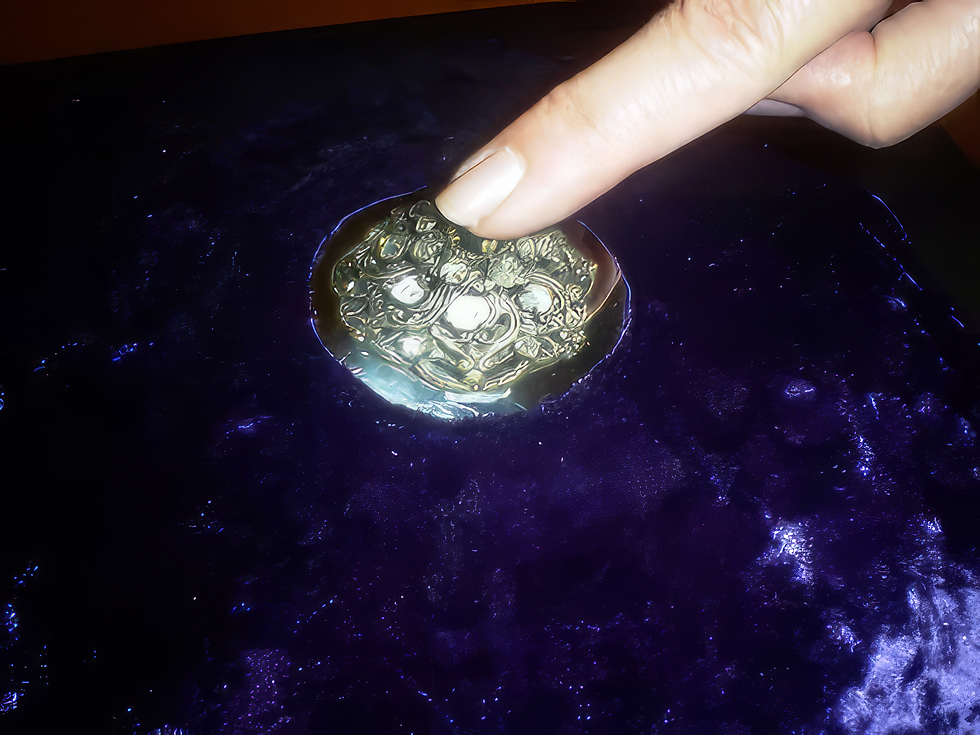
[detalhe] holografia sobre bijoux e veludo Centro Cultural Parque das Ruínas

[detalhe] holografia sobre bijoux e veludo Centro Cultural Parque das Ruínas

[detalhe da Instalação] resina acrílica, pintura vitral e espelho 44cm de diâmetro

Vista da Instalação dimensões variáveis Centro Cultural Parque das Ruínas

Vista da Instalação dimensões variáveis Centro Cultural Parque das Ruínas

Vista da Instalação dimensões variáveis Centro Cultural Parque das Ruínas
THE TWO FACES OF REFLECTION
A multiplicity of perceptions inhabits Gustavo von Ha’s work, in a creative alchemy in which multiple reflections converge, inviting the viewer to diverse sensory and imaginative experiences. His installation Daily Mirror(s) is site-specific and opens new perspectives within his practice—it reveals fragmented combinations and mysterious ambiguities.
The series of mirrored “spheres” is the result of a refined process. Von Ha makes use of new technologies, employing industrial materials such as acrylic and metalizing the surface of the sphere, creating a carefully controlled mirroring directed by the artist, who never loses sight of his main object: painting. His gesture involves brushstrokes and colors of delicate subtlety. The multiple layers of paint that the artist introduces into the spheres—pink, magenta, green, violet, and deep blue—reveal an intimate dialogue between his pictorial gesture and the mirroring of analogous images. Within them, reflections are continuously processed and altered according to light and landscape.
Von Ha’s painting/drawing on mirrors theorizes and enacts the methods of ancient calligraphers, creating codes and signs drawn from the everyday imagery of any visual artist, so that the drawing on the mirrors appears as a graphic inscription of gesture, grounded in the sum of the convex planes of reflection.
One can observe that, on a reduced scale, the painted spheres, arranged as they are, generate a serial presentation of various fragments of the real world. In this way, they propel the viewer into a new field, within two simultaneous focal points. This ambiguity certainly inspires the viewer to look at themselves, deny and affirm themselves, as in Alice’s experience, within a renewed world that reflects the optical transience of the sphere and the expansion of reflections, since the artist constructs an illusory mirroring through exercises in density and image.
Von Ha’s work transforms space into spectacle, and the installation goes beyond contemplation, immersed in reflective and convex images that expand the limits of what is possible to see in contemporary art—much like the transitive relationship between art and society. His work suggests an openness to movement, allowing for the emergence of new mechanisms of aesthetic perception, such as the fragmentation of contemporary culture. Through various variations of fragments of the real world, the artist thrusts the viewer toward multiple simultaneous focal points, giving form to an external force—the “shadow of the other,” the illusion of reality—and the work installs itself there, in the moment of its own visions.
One cannot forget the influences of Warhol, American Pop, Leonilson, Leda Catunda, and the distinct concerns of Anish Kapoor. Von Ha unravels images and, within this paradoxical atmosphere, exhales what lies latent in our retinas, in memory, in dissonance—the existential and universal sensations of everyday boredom. As a result, his work remains in the imagination of those who traverse mirrored paths. The viewer is given the opportunity to confront giving and living, and to glimpse—within the double, the play of mirrors, the dynamic drive of life itself.
Inaccessible and dissociated, fleeting images are re-edited through a process of self-discovery, in a continuous and uninterrupted movement. One perceives, then, an almost playful gaze that invites the viewer to confront the ambiguity of their own being. Multiple visions of images are thus revealed, absorbed, and celebrated, evoking the figure of humankind and identity as imposed form. The human figure, mirrored, walks alongside emptiness, where existence is digested at the limits of reflection.
Mirror reflections multiply at the crossroads of a visual labyrinth, as if we were in the Hall of Mirrors at Versailles. To confuse and create a more experimental atmosphere, Von Ha includes in the exhibition a video made in August 2006, allowing the filmed images to interpenetrate the various images and reflections of the installation.
In the video, a diaphanous female figure, filmed by the artist on the lawns of Central Park, moves among soap bubbles and green and purple mirrored spheres. Even on the plane of reverie, these images stimulate the possibility of counterpoint, of exploring the space of others. Here, the gaze is placed at the service of images, not the reverse. This projection, within the installation, shifts the question of landscape into the interior space and creates another surface that receives projected images, forming new scripts that are reflected in the translucent and mirrored spheres on the floor and walls. This extraction/incrustation operates at a particular stage of consciousness: the projection passes over us passively, transporting flashes and casting them outward.
The excess of information—which should result in intrusive images—actually produces a metamorphosis of images, something we might consider “a simulation of contemporary life.” The installation thus embodies the communication of messages, corrects the constant insertion of data, the excess of media waves, and the accumulation of information. In reality, the mirrored spheres could perhaps be described as “projectors and extensions of reflective action.”
The volumetry of the mirrored spheres transfers onto a surface of illusion, decoding space in topological motion. The lawns of Central Park, with translucent green spheres and luminous images, appear in ephemeral intersections within the space of nature. At this moment, confusion between reality and representation is introduced, recalling the “allegory of the cave” in Platonic thought.
Conceptualizing this proposal as “relativity,” Von Ha presents, for the first time, a hologram—Pandora’s Box—a virtual image in its pure state, through which he reaffirms the artist’s position as a creator of illusions, duplicating and dematerializing the work of art. Here, the image is real; it attains physicality. Created using two concave mirrors metalized on the inside and painted black on the outside, this hologram—a method discovered and developed by American Bob Krick in Michigan in 1977—is perceived by our eyes as a dialectical image of past and present, real and unreal, and the principle of infinity.
In other words, the projection of the real image appears concretely; it is not an illusion, but constitutes a memory of the present of parallel worlds. It remains mysterious and translates the anxiety of becoming.
Indeed, Von Ha enables a mixture of focal points and interferences that enrich our experience, establishing contacts and creating a bridge that highlights the image of immutable determination of the here and now.
Cristina Burlamaqui
Rio de Janeiro, November 2006